
Alison Cook Beatty Dance
Theater for the New City
New York, New York
April 11, 2026, evening
Program B: Her(e), Top Heavy (world premiere), Pastoral, Murmeration (excerpts), Manifestations, Transformation & Empowerment
Jerry Hochman
I’ve been attending performances by Alison Cook Beatty Company (“ACBC”) for roughly seven years. During that time, I’ve seen everything from a Covid-inspired baseball dance in Central Park to an on-stage heart attack, from humans mimicking birds to humans mimicking humans. And I’ve got to hand it to Cook-Beatty, her choreographic imagination never ceases to amaze. Sometimes a particular piece doesn’t work (at least to me), more often one does, but in all cases her dances emphasize subject matter variety that’s difficult to find elsewhere, particularly in a small company still (relatively) new.
I found out fairly recently that Cook-Beatty was a member of Taylor 2, and had performed with Paul Taylor Dance Company. Even more recently (at this performance) I learned that while a student at Boston Conservatory she trained in Graham technique and performed Appalachian Spring (the Bride) under the direction of Yuriko and her daughter (ironically, after I’d just seen Appalachian Spring in a Martha Graham Dance Company performance that same afternoon), and that she’d continued training at the Graham School after her graduation and while she was affiliated with the Taylor companies. [Taylor himself, as is well known, had been a member of the Martha Graham Dance Company.] That kind of background is not only impressive by itself, but it provides a hint of where she’s choreographically coming from. There’s a measure of stylistic similarity from one piece to another, but her dances overall demonstrate remarkable subject matter invention and variety.
So it was with the ACBD program I attended last Saturday evening, the second of two overlapping programs presented at Theater for the New City in the East Village. Six pieces were presented, including one world premiere and one that consisted of excerpts from a larger dance (one that I’d previously seen and reviewed). Everything else was different.
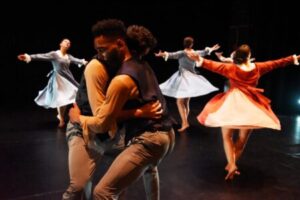
By far the finest dance on the program and to my eye the finest dance created by Cook-Beatty of those I’ve seen (which in no sense whatsoever should be taken as a backhanded compliment), and one of the most original that one can find anywhere, is Manifestations.
Its subject, broadly stated, is reconciling, or being unable to reconcile, parental expectations with a child’s needs. More specifically in the situation that the dance presents, it concerns a mother’s response to her son’s attraction to an “outsider” – in this case in the context of a budding homosexual relationship, but it could have been a relationship with anyone who does not share a parent’s cultural background and beliefs. And by the way it’s structured, Manifestations may also simply be “about” a mother’s dreams or expectations with respect to the future of her newborn child, which I’ll try to explain below. Regardless, in its psychological explorations and revelations, Manifestations is as close to psychodramas choreographed by Sir Anthony Tudor as anything else within my memory.
in “Manifestations”
Photo by Russell Haydn
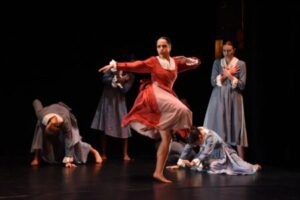
Manifestations takes place in a close-knit, apparently religion-based and/or morality-based and/or issue-based community, or all three. Examples that come quickly to mind would be Amish, Chasidic (ultra-orthodox) Jewish, Quakers, Shakers, the Fundamentalist Church of Jesus Christ of Latter Day Saints, and groups/cults that encourage one to drink the Kool-Aid, but I’m sure there are others. [Given that the piece includes many of the dancers flung across the stage floor, in similar outfits, shaking, makes Shakers a safe bet.] These groups often have strict limits on what a member can or cannot do or believe. So here, the mother’s ultimate refusal to accept her son’s homosexual relationship would appear likely to be based on the teachings/restrictions of her community, which match her own deeply held beliefs..
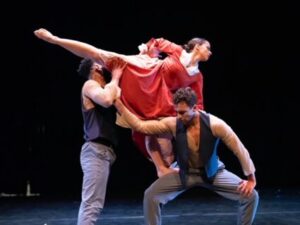
The dance includes specifically-identified generically-named characters: “Mother,” danced by Ava Trochiano: “Son,” portrayed by Marcos Antonio; and “Outsider,” by Facundo Ferreyra. And there are also five “Village People,” danced in various combinations and subsets, by Owen Lunsford, Chynna Holder, Madelaine Burnett, Ioanna Ioannides, and Makenna Zelenak. It’s choreographed to John Adams’s “Shaker Loops,” a perfect choice here even aside from its title. The music is played by string instruments that can change from rapid-fire screeches to a comforting serenade (far more of the former than the latter) in a heartbeat.
in Alison Cook-Beatty’s “Manifestations”
Photo by Russell Haydn
Cook-Beatty and her cast weave a wrenching story of real or anticipated family (immediate and/or community) values and lines that cannot or will not be crossed. After the assemblage is introduced (not literally – by appearances as the dance begins), the plot, to the extent there’s a real one, begins. Son, devoted to Mother and she to him, appears interested in a relationship with Outsider. While that relationship might arguably relate to any quality, here it’s apparent that the relationship described is homosexual.
In a nutshell, Son “introduces” Outsider to Mother, who understands the situation and rather than accepting it, goes ballistic. The Village People respond to stage events as or after they happen, appearing to agree or disagree with whatever situation had been (or was being) depicted, but also, overall, emphasizing the volcanic emotional action.
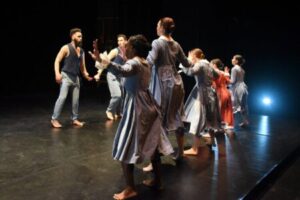
Photo by Russell Haydn
As the piece progresses, the relationship between Son and Outsider deepens. The more that Son tries to convince Mother that the relationship is true as well as real, Mother becomes increasingly impassioned and angered by what she sees Son doing. At one point, she retreats to her corner of the stage (most likely her home) and briefly rocks and cuddles a blanket that’s clearly supposed to hold a newborn infant.
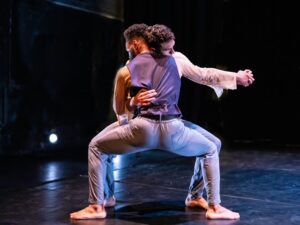
in Alison Cook-Beatty’s “Manifestations”
Photo by Russell Haydn
The relationship between Son and Outsider continues to deepen and become more intense, a fact that the dance makes apparent, to the point where one assumes they are then a “couple.” Mother watches in agony, her whole world turned upside down. Initially, it appears that she is finally is about to give up and accept the relationship (and the Village People, who initially opposed Son and his lifestyle, eventually appear comfortable with that decision). But suddenly, she doesn’t. She becomes emotionally yet more violent, not only with respect to the relationship (although she knows there’s nothing she can do about it), but to the environment that allowed this to happen – slashing and ripping through the air like an animal uncaged. Then, calmly, she retreats to her personal corner of the stage, sits, and again begins to sway the infant-containing blanket as she had earlier, her mind and body fixed and emotionless, in serenity and emotional peace, cuddling her child – which is when the dance ends.
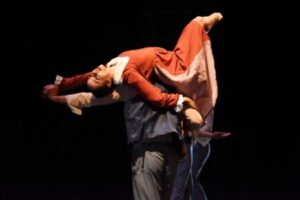
in Alison Cook-Beatty’s “Manifestations”
Photo by Russell Haydn
It’s not only the story per se or the situation that makes Manifestations as fine a work as it is; it’s the vividly choreographed and expressed interaction of the characters (not an ounce of superfluous movement or emotion) that make the events depicted on stage real. And the dance is not at all judgmental with respect to the actions and positions of any of the characters. The characters are who they are; it is what it is.
The elaboration above is a nutshell description. But Manifestations doesn’t easily lend itself to such encapsulation.
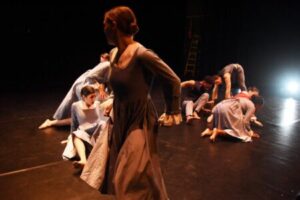
in “Manifestations”
Photo by Russell Haydn
Let me explain. The dance can be limited to its particular facts and fact-setting, which would make it no less impressive an accomplishment. But I don’t think it should be. There are too many ambiguities that universalize its scope, which may or may not have been intended. And it also can be considered as visualizing multiple levels of events, and multiple scenarios and explanations, and …. manifestations. Manifestations may be more complex than it appears to be on the surface. And please forgive my overthinking.
For example, is the image of Mother cradling that blanket with an infant in it her recollected memory of Son as an infant? I thought that’s what it was, but having the same image at the dance’s conclusion directs a viewer, at least this viewer, to think that this final image is not another recollected memory, but a reality. And if a reality, is it a reality within the context of the story, or outside it. And if outside it, can it mean that the story is being told in the context of a mother’s dream of her child’s future, which turns into a mother’s nightmare. That is, if the image is outside the parameters of the story, either the story never really happened, or the baby inside the blanket the second time is a different baby.
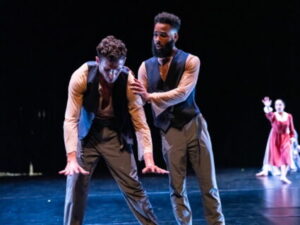
in Alison Cook-Beatty’s “Manifestations”
Photo by Russell Haydn
In the end, of course, little of this really matters – it’s just a head-scratching opportunity. BUT, aside from the basic story, there are characteristics of the story that give it a wider scope than just being limited to the facts presented on stage. For example, the Village People don’t necessarily oppose the actions taken by any of the identified characters: they observe them. So even though the stage environment is of a close-knit, affinity-based community, in reality (real reality) they’re akin to a Greek Chorus that observes or comments on the action on stage, but, matching the neutral outlook of the piece as a whole, doesn’t necessarily compel any of it or act as enforcer for community values. This opens the context of the matter to any community setting, large or small, affinity-based or not.
And everyone assumes, as I did, that Mother and Son are Mother and Mother’s Son. However, the fact that the cast–listing identifies the characters as it does may imply something else: an intended (or unintended) sense of universality that removes the characters from their place-holding positions in the dance and places them in a context of, potentially, “every parent” and “every child,” and “every” situation in which there’s a line that cannot be crossed, for whatever reason (cultural, societal, personal). Situations like marrying outside the family’s religion or converting to a different religion, or inter-racial marriage, or committing some heinous crime, or having an abortion or supporting legislation that criminalizes it, or coming out, or becoming addicted, or even voting for a politician that the parent abhors.
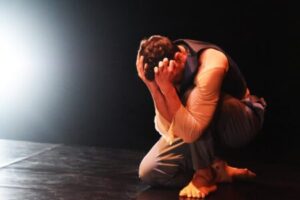
Photo by Russell Haydn
But even if limited to the situation as presented, Manifestations is a compelling work of dance art, immeasurably enhanced by the performances I saw here. Without exception, the cast, and particularly the three named characters, danced this visual minefield with competence, command, and compassion.
Each of the Village People, led by Burnett (who to my recollection appeared solo more than any of the others) danced their roles well. Ferreyra’s Outsider wasn’t given much to do beyond being the target of Son’s interest, but he demonstrated the essential attraction and commitment well. Son was the stronger character because he’s pictured as more than being the other half of a relationship (with both Outsider and Mother) – he had to made his involvement with Outsider look real, and he also had to make his parent-child relationship and his begging for Mother’s compassion and understanding look real, and Antonio did. His was a compelling performance.
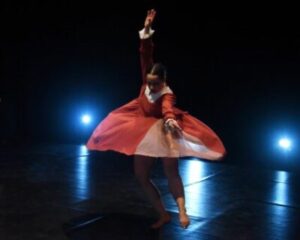
Photo by Russell Haydn
But the most impressive performance was Trochiano’s Mother. The role is far from being as one-dimensional as it may sound, and Trochiano, to my view, nailed every aspect of it. She was the person a viewer most liked or hated, but she was also, whether one agreed with her position or not, the one that an audience could most relate to. Her passion was real, as was her anger and agony – and fear. Overall, her performance was sensational; one of the finest of any I’ve seen in any context.
It’s astonishing to me that a company of such limited size can create and execute a dance that digs so deeply, and so well, into human nature and human emotions. As the reader here may have gathered, I liked Manifestations a lot. Although other dances may be seen and promptly forgotten, Manifestations remains etched in the mind long after the actual dance ends.
Using as much space as I have on Manifestation was, I felt, necessary. But I’m left with less space to deal with the other dances, which is an unfortunate consequence. So forgive me if I seem to give the program’s other dances short shrift.
Although these other dances weren’t at all bad, to my eye nothing else on the program equaled the impact of Manifestations.
The evening opened with Her(e), which had its NYC premiere the previous night (and had its world premiere a month earlier in New London, CT). The same eight dancers who later appeared in Manifestations danced in this piece as well.
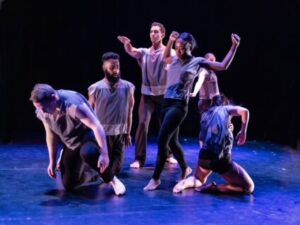
Photo by Russell Haydn
In an Instagram post (there are no program notes), Cook-Beatty states that Her(e) “explores the tension between the individual and the collective. As the system begins to fracture, Ava fights to break free – while Makenna exists just outside its bounds, witnessing, holding, and resisting in her own way. A journey of control, rupture, and becoming.”
Like Makenna Zelenak’s character, I only saw the dance from the outside looking in – something like an individual and the collective.
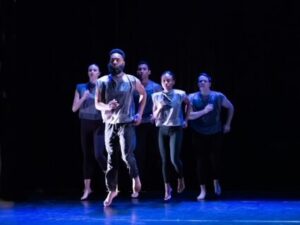
Photo by Rob Klein
I did note seven of the dancers “confined” (limited in spatial movement) within a common area, and Zelenak slowly, passively, circling around the perimeter of this “closed” area, gazing at whatever was happening inside. And I saw Trochiano moving with greater determination and apparent anger than the others. But I had no clue why this was happening. I thought briefly that the pseudo-enclosed area might have been a prison, with Zelenak as a security guard. Or that it might have been a gym, where the members build strength and exhaustion, with Zelenak wondering whether she should join. Or maybe that it was Best Buy during Black Friday (back when it hadn’t yet been supplanted by online Black Fridays that could last weeks), with the people inside in a frenzy and Zelenak waiting her turn to join them. Obviously, none of these scenarios, or anything else I could think of, worked.
Maybe on a second view I’ll see Cook-Beatty’s intent (and a reason for the title – Her(e) – more clearly.
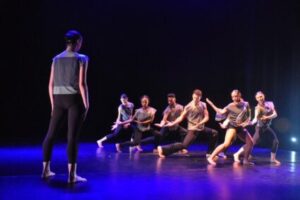
Photo by Rob Klein
Her(e) was followed by the evening’s world premiere: Top Heavy. Unlike the other pieces, Top Heavy doesn’t appear to have any particular meaning, and its intent is to entertain – which matches well with the score Cook-Beatty used, Claude Debussy’s Children’s Corner, movement 6 (Cakewalk – originally Golliwogg’s Cakewalk), a rag (ragtime) derived from minstrel show cakewalks, recorded by British pianist Isata Kanneh-Mason. Debussy created the piece for his daughter. Like its score, “Top Heavy” is it’s light and frothy and at times funny. It’s also somewhat juvenile.
Four dancers (Ioannides, Trochiano, Lunsford, and Ferreyra) appear on stage, each wearing a different “hat” (“head covering” might be more appropriate). One of them wears a red feathery or flower had, another a yellow flower-like hat, and the other two wear black top hats. Ioannides, who wore one of the black top hats (apparently, based on the photos below, after switching hats with Trochiano) seemed to be the leader, but that might have been because she wore a hat that was a hat.
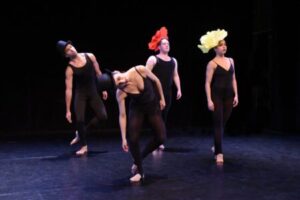
and Ioanna Ioannides in Alison Cook-Beatty’s “Top Hat”
Photo by Russell Haydn
Overall, the array led me immediately to think I’d jumped into a rabbit hole. But if that was part of the intent, there was no follow-through.
The dance’s title is an allusion to the wearing of a hat making the wearer feel “top heavy” (or to an audience’s perception that the dancer’s appearance is “top heavy).” But it has a function hear – the hat is so heavy that it make it difficult for the wearer to walk, either upright or in a straight line. Eventually, all four fall to the floor.
That’s it. That’s the dance.
My initial take was that this was a bit of comic fluff; a respite from the more serious choreographic stuff. It wouldn’t surprise me, however, if Cook-Beatty had a deeper motive here relating to “cakewalk” and its origins. But based on what I saw, there didn’t appear to be any.
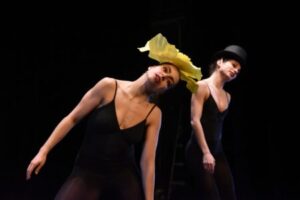
in Alison Cook-Beatty’s “Top Heavy”
Photo by Russell Haydn
Created in 2000 at the Boston Conservatory (as noted above, from which Cook-Beatty graduated) Pastoral was the program’s oldest dance. Since ACBD was founded in 2012, it perhaps is the product of a school choreographic assignment, which is how it appeared to me.
Three dancers (Burnett, Ioannides, and Trochiano) appear to be in an open field, while the audience hears a score of serene, almost bucolic music. The dancers are celebrants of nature in all its fresh air glory (at least for now). After the opening moments, when the elegantly-dress dancers lift their heads up as if they’re greeting the sky, there’s movement that is continuous and joyous.
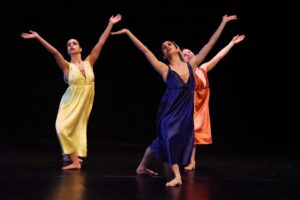
in Alison Cook Beatty’s “Pastoral”
Photo by Russell Haydn
I wonder how the dance would look if it were choreographed now, given the seeming abandonment of public open space and limitations on National Parks. I suspect it might be more somber, with movement that is more like trying to recover something lost rather that enjoying what they’ve found. But for now at least, the dancers obviously enjoy the open air, relishing the atmosphere and maybe the view, and perhaps passing a stream or lake (the dance’s score is Handel’s “Water Music, Suite No. 3 in G Major,” Movement I Lento, edited by the multi-talented Trochiano). It’s a happy little dance, one that’s really not bad for a choreographed assignment, if that’s how it originated, and it’s sufficiently pleasant to watch and dream of abandoning the city and vegetating quietly in an open field, hopping or running around a little for exercise, but otherwise just feeling the breeze … for an hour or two, or maybe a week or two.
Prior to intermission, the company presented excerpts from Murmuration, a piece that premiered in 2016. I saw and reviewed a subsequent performance of it in 2021.
This presentation was particularly well done, with Burnett, Chyna Holder, Ioannides, Trochiano, Ferreyra, Zelenak, and Antonio comprising the excerpt’s cast.
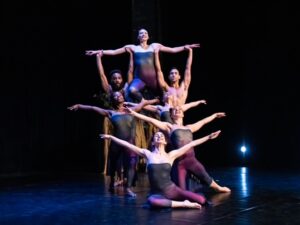
Photo by Rob Klein
In my 2021 review, I described Murmurations as follows:
“The evening closed with the only dance not a product of pandemic creativity, Murmuration. Created by Cook-Beatty in 2016, it’s a happy-as-a-lark dance essentially personifying birds looking happy as a lark – or a bluebird, or a starling. According to the program note, the piece was inspired by the aerial ballet of the starlings that gather in flocks forming murmurations (a word I’m not acquainted with, but I suppose it means what it sounds like)….Choreographed to Ottorino Respighi’s “Gli Uccelli” (The Birds) (of course), the dance is a lot of fun to watch, providing a birds-eye view of the clear distinctions between the bird personalities and bird-like movements. The beautiful costumes were designed by Christine Darch. It’s not in any way Hitchcockian, there was not a pigeon in sight, and it sent the audience home happy. But where was the Bluebird? I was sure there was a Bluebird, dancing (simulating) the characteristic movement of the Bluebird in The Sleeping Beauty. It must have been the Hen; a very balletic hen.”
Those comments were from my 2021 review. This excerpted presentation focuses on the Mockingbird (including the solo) and the group work—the Starlings. Regardless, I have no reason to depart from the assessment I made in 2021. But possibly because what I saw at this performance was an excerpt, I can’t clearly determine which dancers played which birds (although I suspect that Burnett led the Starlings, as she did in 2021). Be that as it may, the piece, whether it returns in full or again in excerpt, is well worth seeing.
The evening closed with Transformation & Empowerment, which premiered last year in New London, CT. It was danced here by Ioannides, with Burnett and Trochiano.
I’ve read (again, no program note) that Transformation & Empowerment is Cook-Beatty’s take on “Pygmalian” (from which evolved “My Fair Lady”). Again, I didn’t see that here. But the three dancers are the current company veterans, and made solid impressions (if not more) in every piece on the program. This one was no exception. So if I missed the connection that at the time I was unaware of, it’s not due to any deficiency on their part.
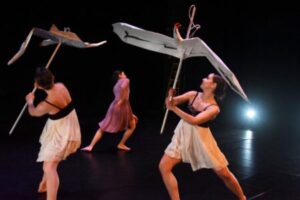
in Alison Cook Beatty’s “Transformation & Empowerment”
Photo by Russell Haydn
Ioannides is the central figure, an apparently lonely character the other two are costumed alike (black tops and white skirts). After a lot of running around the stage and a few Ioannides solos, the other two each carry a long stick with what appears to be a large white bird form attached at the top. They resembled origami cranes, but looked large as white … cranes. Real ones. Or maybe geese.
Anyway, as I saw it Ioannides decides to join them – but without her own crane. Nevertheless, they all fly happily away. .
I saw Transformation & Empowerment not so much as being about trying to make a statue come to life or equip a sorry little bird into a regal looking crane, but about conforming; feeling better about oneself by joining others.
And as the three dancers seemed to be flying away, the program did as well.
Source: https://criticaldance.org/alison-cook-beatty-dance-manifestations-of-excellence/